3 Fundamental GEO Strategies to Integrate into Your Digital Marketing Strategy
3 Fundamental GEO Strategies to Integrate into Your Digital Marketing Strategy
3 Fundamental GEO Strategies to Integrate into Your Digital Marketing Strategy
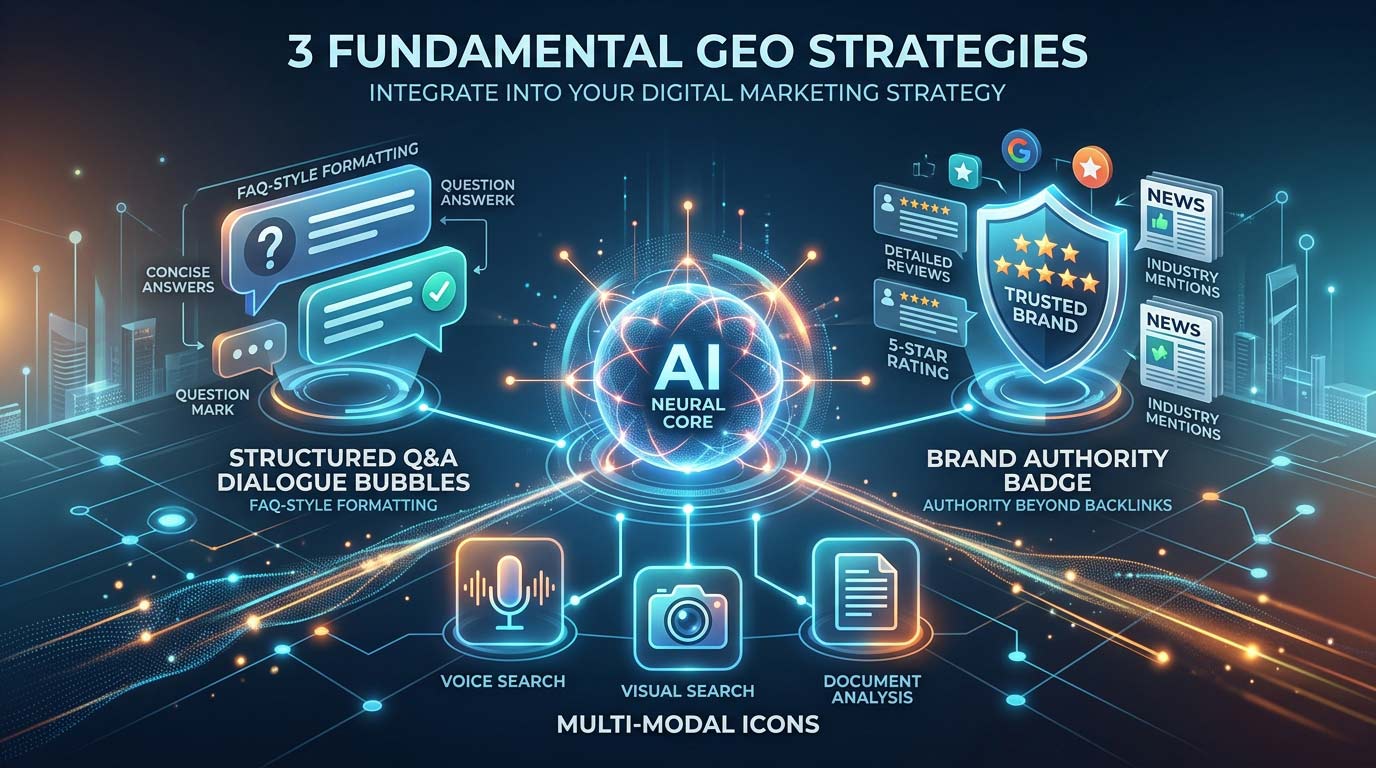
As AI overviews and zero-click results become the new standard, digital marketing is rapidly evolving. So, how do you adapt your website to become AI’s top recommendation? It requires a shift from writing for search engine algorithms to structuring information for large language models. Here are three ways that you can integrate GEO into your digital marketing strategy.
1. Master FAQ-Style Formatting
AI models process information differently than humans. When a user prompts an AI search, the model scans the web looking for the most accurate and concise answer. To make your content easily digestible for these models, you need to shift toward question-and-answer formatting.
Instead of burying key information deep within marketing copy, structure your pages using clear headings that mirror the exact questions your audience is asking. Follow a question directly with a short, concise answer. Removing jargon and delivering straightforward answers makes it easy for an AI model to extract and cite your expertise.
Tip: Consider adding dedicated FAQ sections to your core service pages. This not only captures conversational queries but directly feeds AI structured data.
2. Build Authority Beyond Backlinks
Traditional SEO places a heavy emphasis on building a robust backlink profile. While links still matter, AI models are trained to prioritize genuine authority and trustworthiness across the entire web ecosystem.
To win in GEO, you need to establish a comprehensive brand footprint. This means focusing on organic brand mentions in reputable industry publications, forums, and directories. Detailed customer reviews also make a huge difference.
Tip: Encourage detailed reviews on your Google Business Profile and other third-party review sites. When AI cross-references information to form a recommendation, a consistent track record of positive, authentic experiences signals that your business is the best choice.
3. Optimize for Multi-Modal Search
Search is no longer confined to a text box. Users are continuously turning to voice assistants, smart devices, and camera-based searches to find what they need. Because AI seamlessly blends text, audio, and visual inputs, your GEO strategy must be multi-modal.
If your website relies heavily on images and videos, you need to ensure that AI can interpret them. Tag all visual assets with descriptive, accurate metadata and alt text. Implement schema markup to provide crawlers with clear context about your multimedia elements. When an AI model can understand your visual content, it’s much more likely to pull those assets directly into a generated summary.
The Bottom Line
By implementing FAQ-style formatting, building brand authority, and optimizing for multi-modal search, you give AI exactly what it needs to recommend your business. Adapting your digital marketing strategy today ensures your business remains visible in the zero-click landscape.